Brand
Beaver
Beaver was an Oregon builder of high-end diesel motorhomes. Jim Hogue and Frank Storch started the business in the 1960s, and its coaches were built in Bend for decades. After Beaver went bankrupt, SMC Corporation, the maker of Safari coaches, bought it in 1994. Monaco Coach Corporation bought SMC in 2001 and moved Beaver production to Coburg, Oregon, in 2005. The last Beaver coaches were finished in 2009, after Monaco's own bankruptcy.
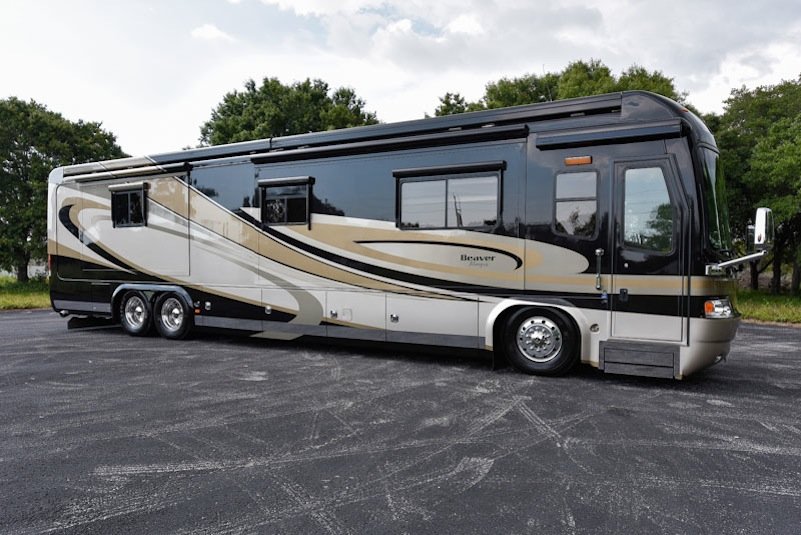
Photo: The Motorcoach Store · All rights reserved
Models
Marquis
Class A
Solitaire
Class A
Patriot Thunder
Class A
Patriot
Class A
Contessa
Class A
Monterey
Class A
Santiam
Class A
History
Beaver began as a small Oregon camper business. According to the club-run Beaver Motorhome History site, Jim Hogue and Frank Storch started the company in 1966 in a two-car garage in Corvallis, and the same site dates Beaver Coaches Inc. from 1968. Beaver Coach Sales, the Bend dealership, says the two men moved their business to Bend in the late 1960s. Wikipedia says the first products were slide-in campers for pickup trucks and that Class C motorhomes followed around 1974.
Wikipedia also says Beaver began building gasoline Class A motorhomes in the early 1980s, brought out its first diesel motorhome in 1985 and had 225 workers at its Bend plant by 1990. The history site records 137 coaches built in 1984, 231 in 1985, 236 in 1986 and 161 in 1987, and says the original company never built more than 400 to 500 in one year. Beaver Coach Sales says a dealership was added at the Bend plant in 1988.
According to Wikipedia, Beaver's debts passed $11 million by November 1993, and it filed for Chapter 11 bankruptcy. SMC Corporation of Harrisburg, Oregon, the company behind Safari motorhomes, bought nearly all of Beaver's operating assets through the bankruptcy, effective June 1, 1994. SMC's annual report says it paid $3.9 million in cash, forgave $3.1 million that Beaver owed it, spent about $400,000 on the deal and agreed to a three-year royalty of at least $1.6 million. SMC's chief executive, Mathew Perlot, had been Beaver's director of sales and marketing from 1985 to 1987.
SMC kept building Beavers in Bend and reworked the lineup. The lower-priced Monterey arrived in the summer of 1995, and in July 1995 the 1996 Patriot moved onto a Magnum B-Series chassis built by SMC's own chassis company. In 1997 the Marquis also moved to a Magnum chassis and became a slower-built prestige coach, while the Contessa name returned on a redesigned model. In the third quarter of 1999 SMC added the 45-foot Solitaire, its most expensive coach, which it built at the Beaver plant but listed under its own name, apart from the Beaver models. Beaver sales were 268 coaches in 1994, peaked at 567 in 1996 and fell to 394 in 2000. SMC moved its headquarters from Harrisburg to Bend in 1998.
SMC lost $5.4 million in 2000. On June 25, 2001, Monaco Coach Corporation of Coburg, Oregon, announced it would buy the company for $3.70 a share, and the purchase was finished in early August 2001 at a cost of about $24.3 million. Monaco kept the Bend plant running. In June 2004 the Bend Bulletin reported that Beaver had 600 workers, built nine coaches a week in Bend and sold them for $200,000 to $555,000. Monaco's annual report for 2002 lists six Beaver lines: Marquis, Patriot, Contessa, Monterey, Santiam and Baron.
In 2005 Monaco moved Beaver manufacturing from Bend to its plant in Coburg and recorded about $4.4 million in relocation costs. By the end of 2007 its only Bend facility was a 12,000-square-foot electrical design and assembly shop. Buyer's-guide listings for 2006 and 2007 show the Beavers of this period on Roadmaster chassis with Caterpillar diesel engines.
The brand ended with Monaco's collapse. According to Wikipedia, Monaco filed for Chapter 11 bankruptcy on March 5, 2009, and Navistar bought its assets that June. Beaver Coach Sales and the history site say two Beaver Contessas were still on the production line; they were finished in 2009 after Navistar's purchase and labeled 2010 models. The history site says no other Beavers were made.
Wikipedia says Navistar sold Monaco's RV business to Allied Specialty Vehicles, now REV Group, in 2013. In 2016 Beaver Coach Sales, a Bend dealership owned by Ty Kelly, bought the Beaver name and the rights to build the coaches. The history site says no new coaches have been produced. The Beaver Ambassador Club, a chapter of the Family RV Association, still serves owners and keeps a library of factory brochures and manuals.
Timeline
Jim Hogue and Frank Storch started the company in a two-car garage in Corvallis, Oregon, according to the club-run Beaver Motorhome History site.
The founders moved their RV building business to Bend, Oregon, in the late 1960s.
Wikipedia says that after starting with slide-in pickup campers, the company began building Class C motorhomes around 1974.
The history site records 137 coaches built in 1984, 231 in 1985, 236 in 1986 and 161 in 1987.
According to Wikipedia, Beaver introduced its first diesel motorhome in 1985.
A dealership was added at the Bend site. It operates today as Beaver Coach Sales.
Wikipedia says the company employed 225 people at its Bend assembly plant by 1990.
The Patriot joined the lineup on a chassis from an outside vendor.
Wikipedia says that by November 1993 Beaver's debts were more than $11 million and it filed for Chapter 11 bankruptcy.
SMC Corporation, parent of Safari Motor Coaches, acquired nearly all of Beaver's operating assets through the bankruptcy, effective June 1, 1994. It paid $3.9 million in cash and forgave $3.1 million owed to it.
SMC introduced the lower-priced Monterey in the summer of 1995 and, in July, the 1996 Patriot on its own Magnum B-Series chassis.
SMC began building the Marquis on a Magnum chassis as a slower-built prestige coach and reintroduced the Contessa as a new design.
SMC relocated its headquarters from Harrisburg, Oregon, to Bend.
SMC introduced the 45-foot Solitaire, a limited-production coach to be built at the Beaver plant, in the third quarter of 1999 at $672,000 to $699,000, and added the 42-foot Amethyst Marquis.
Monaco Coach Corporation announced on June 25, 2001, that it would buy SMC for $3.70 a share. The purchase was completed in early August for about $24.3 million in cash.
The Bend Bulletin reported that the Bend plant had 600 workers and built nine coaches a week, priced from $200,000 to $555,000.
Monaco moved Beaver manufacturing from Bend to its plant in Coburg, Oregon, and recorded about $4.4 million in relocation costs.
According to Wikipedia, Monaco Coach Corporation filed for Chapter 11 bankruptcy on March 5, 2009, and Navistar bought its assets in June 2009.
Two Contessas left on the production line were finished after Navistar's purchase and labeled 2010 models. The club-run history site says no other Beavers were made.
Beaver Coach Sales of Bend, Oregon, owned by Ty Kelly, acquired the intellectual and production rights to Beaver. The club-run history site says no new coaches have been produced.
Sources
- Beaver Motorhome History
- Beaver Motorhome History — Beaver Coaches Inc (1968–1994)
- Beaver Motorhome History — Brochures 1968–94
- Beaver Motorhome History — Brochures SMC
- Beaver Motorhome History — Brochures Monaco
- Beaver Motorhome History — Navistar (2009 to 2013)
- Beaver Motorhome History — Beaver Coach Sales (2016 to present)
- Beaver Ambassador Club
- Beaver Ambassador Club — Coach Assist
- Beaver Ambassador Club forum — History of the Beaver Brand?
- Beaver Ambassador Club forum — Beaver Models
- Steve Rankin's Beaver Motor Coach information site
- Beaver Brochure Archive (Steve Rankin)
- SMC Corp Form 10-K for fiscal year 1996 (SEC EDGAR)
- SMC Corp Form 10-K for fiscal year 1997 (SEC EDGAR)
- SMC Corp Form 10-K for fiscal year 1998 (SEC EDGAR)
- SMC Corp Form 10-K for fiscal year 1999 (SEC EDGAR)
- SMC Corp Form 10-K for fiscal year 2000 (SEC EDGAR)
- Monaco Coach Corporation Form 10-K for fiscal year 2001 (SEC EDGAR)
- Monaco Coach Corporation Form 10-K for fiscal year 2002 (SEC EDGAR)
- Monaco Coach Corporation Form 10-K for fiscal year 2003 (SEC EDGAR)
- Monaco Coach Corporation Form 10-K for fiscal year 2004 (SEC EDGAR)
- Monaco Coach Corporation Form 10-K for fiscal year 2005 (SEC EDGAR)
- Monaco Coach Corporation Form 10-K for fiscal year 2007 (SEC EDGAR)
- SEC EDGAR — Monaco Coach Corporation annual reports
- Bend Bulletin — Beaver Coach at cruising speed, despite the high price of diesel (June 9, 2004)
- Beaver Coach Sales — About Us
- Wikipedia — Beaver Motorcoach Corporation
- Wikipedia — Monaco Coach Corporation
- The Auto Channel RVmotoring buyer's guide — Beaver
- Beaver Contessa 2008 Owner's Manual (ManualsLib copy)
- RM Sotheby's — 1999 Beaver Marquis 40-Foot
- RM Sotheby's — 2006 Beaver Patriot Thunder 42' Motorhome